OFF-CLIP: Improving Normal Detection Confidence in Radiology CLIP with Simple Off-Diagonal Term Auto-Adjustment
Junhyun Park*, Chanyu Moon*, Donghwan Lee, and 2 more authors
In Proceedings of the 28th International Conference on Medical Image Computing and Computer-Assisted Intervention (MICCAI). Early accept (top 9%) , 2025
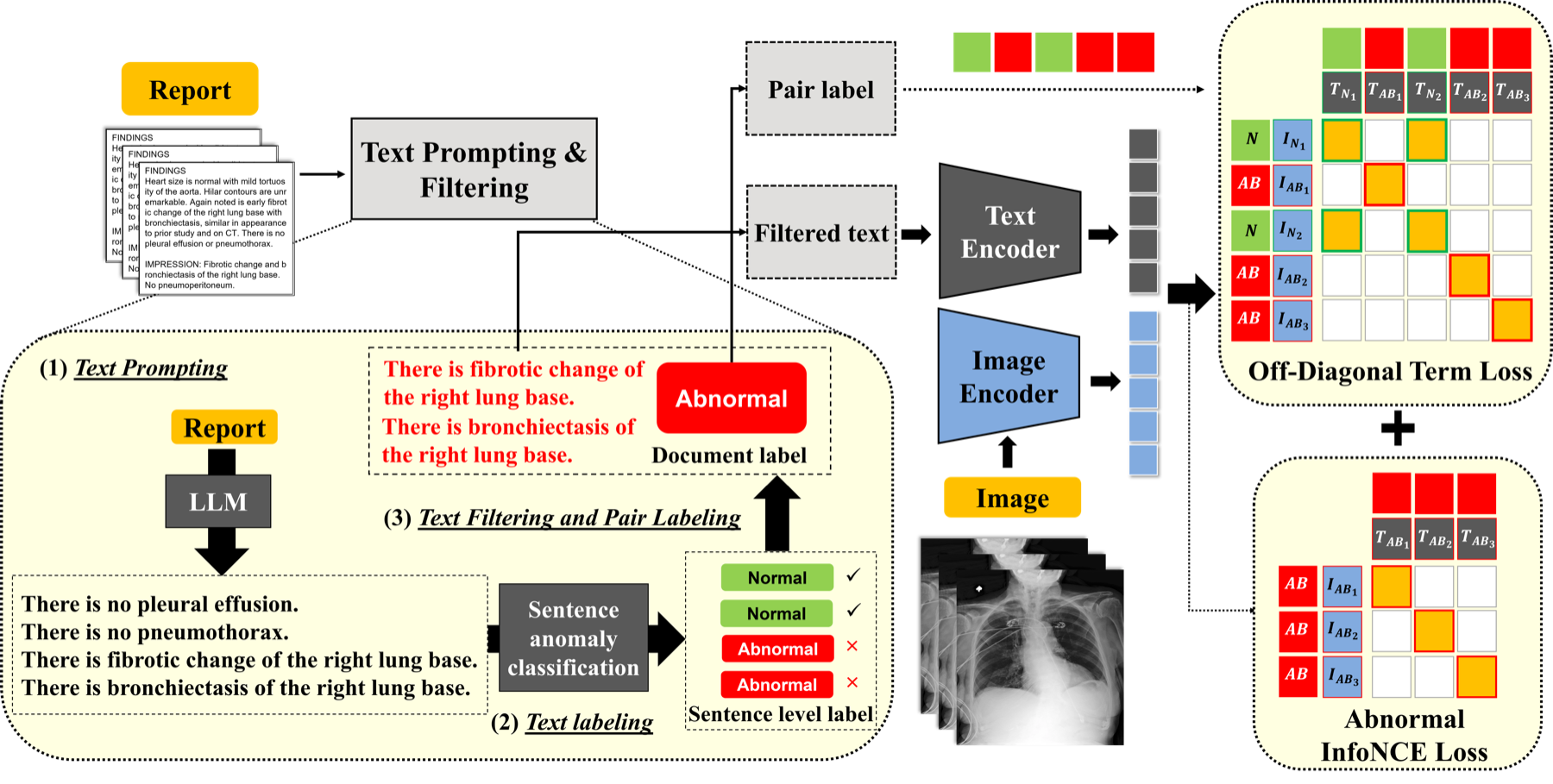
Contrastive Language-Image Pre-training (CLIP) models for radiology suffer from high false-positive rates on normal images. We identify two causes: conventional InfoNCE treats different normal patients as negative pairs, preventing a cohesive normal cluster, and reports of abnormal patients contain normal sentences that are forced to align with abnormal images. OFF-CLIP addresses these with an off-diagonal term loss that treats all normal samples as positive pairs, and with sentence-level text filtering that removes normal descriptions from abnormal reports. Applied to CARZero, OFF-CLIP substantially improves normal detection while maintaining abnormal classification performance on VinDr-CXR, Open-I, PadChest, and CheXpert.
@inproceedings{park2025off,title={OFF-CLIP: Improving Normal Detection Confidence in Radiology CLIP with Simple Off-Diagonal Term Auto-Adjustment},author={Park, Junhyun and Moon, Chanyu and Lee, Donghwan and Kim, Kyungsu and Hwang, Minho},booktitle={Proceedings of the 28th International Conference on Medical Image Computing and Computer-Assisted Intervention (MICCAI)},year={2025},}
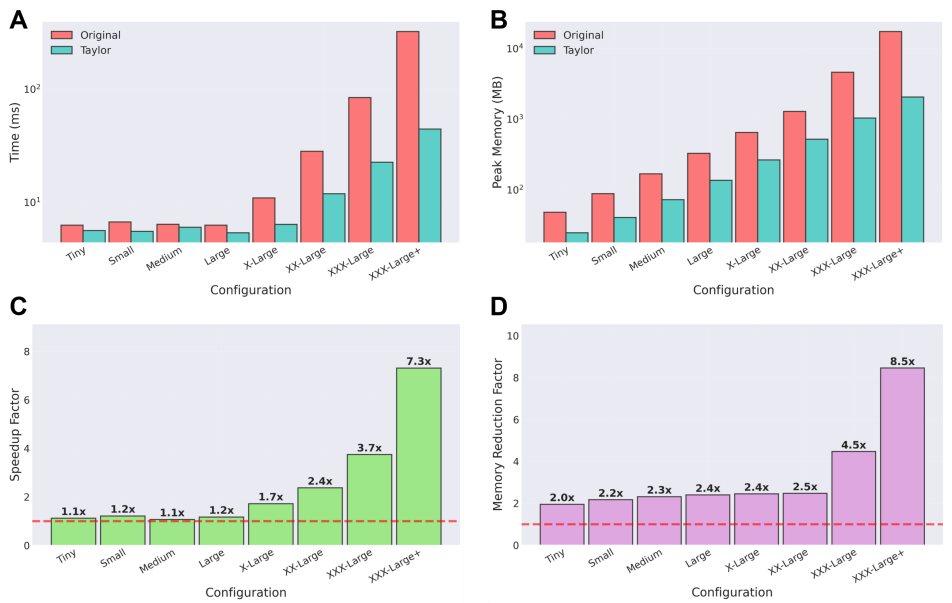
Contrastive learning has become a cornerstone for self-supervised time-series representation learning, yet its practical application is often hindered by the quadratic computational and memory complexity of the standard InfoNCE loss. We leverage a first-order Taylor expansion to approximate the InfoNCE loss, circumventing the explicit computation of the full similarity matrix and reducing the complexity to a linear scale. Integrated into TS2Vec and evaluated on the UCI Human Activity Recognition benchmark, our approach achieves up to a 7.3x speedup and an 8.5x reduction in peak memory usage while maintaining classification accuracy comparable to the original model.
@inproceedings{jeong2025efficient,title={Efficient Biomedical Time-series Contrastive Learning: Revisiting Taylor Expansion in Loss Optimization},author={Jeong, Yunho and Moon, Chanyu and Kim, Jinmo and Choi, Ji-Woong},booktitle={2025 16th International Conference on Information and Communication Technology Convergence (ICTC)},pages={146--151},year={2025},organization={IEEE},}
파킨슨병 환자에서의 적응형 뇌 심부 자극 기술 동향에 대한 조사 연구 (A Study on the Trends of Adaptive Deep Brain Stimulation in Parkinson’s Disease)
Chanyu Moon and Ji-Woong Choi†
In 한국통신학회 학술대회논문집 (Proceedings of the Korean Institute of Communications and Information Sciences Conference). Oral presentation (DGIST special session) , 2025
Adaptive deep brain stimulation (aDBS) has been introduced to overcome the limitations of open-loop deep brain stimulation, a symptom-relief therapy for patients with Parkinson’s disease. This study reviews recent research trends on input signals and stimulation parameter control for aDBS in Parkinson’s disease patients.
@inproceedings{moon2025adbs,title={파킨슨병 환자에서의 적응형 뇌 심부 자극 기술 동향에 대한 조사 연구 (A Study on the Trends of Adaptive Deep Brain Stimulation in Parkinson's Disease)},author={Moon, Chanyu and Choi, Ji-Woong},booktitle={한국통신학회 학술대회논문집 (Proceedings of the Korean Institute of Communications and Information Sciences Conference)},pages={307--308},year={2025},}