Efficient Contrastive Learning
Linear-complexity InfoNCE via first-order Taylor expansion for biomedical time series (ICTC 2025)
Period: 2025.02 – 2025.10 · Role: Co-first author. Led the mathematical formulation of the first-order Taylor approximation.
Problem
The standard InfoNCE loss requires a batch-by-batch similarity matrix, so memory and compute grow quadratically with batch size.
Method
Writing the second term of InfoNCE as \(f(t) = \log \sum_j \exp(st)\) and expanding around \(t = 0\) gives \(f(t) \simeq \log B + \left(\frac{1}{B}\sum_j s\right) t\). Substituting \(s = r_i \cdot z_j\) and \(t = 1\):
\[\mathcal{L}_{ap} = -\frac{1}{B} \sum_{i}^{B} (r_i \cdot z_i) + \log B + \left( \frac{1}{B} \sum_{i}^{B} r_i \right) \cdot \left( \frac{1}{B} \sum_{j}^{B} z_j \right)\]The cross term reduces to a dot product of batch means, so no similarity matrix is ever formed.
Results
Integrated into TS2Vec and evaluated on UCI HAR:
| Method | Accuracy | AUPRC | Time (s) | GPU peak (MB) | Throughput (items/s) |
|---|---|---|---|---|---|
| Original | 0.9213 | 0.9485 | 60.1 | 20576.0 | 122.4 |
| Taylor | 0.9087 | 0.9291 | 31.9 | 8214.0 | 230.6 |

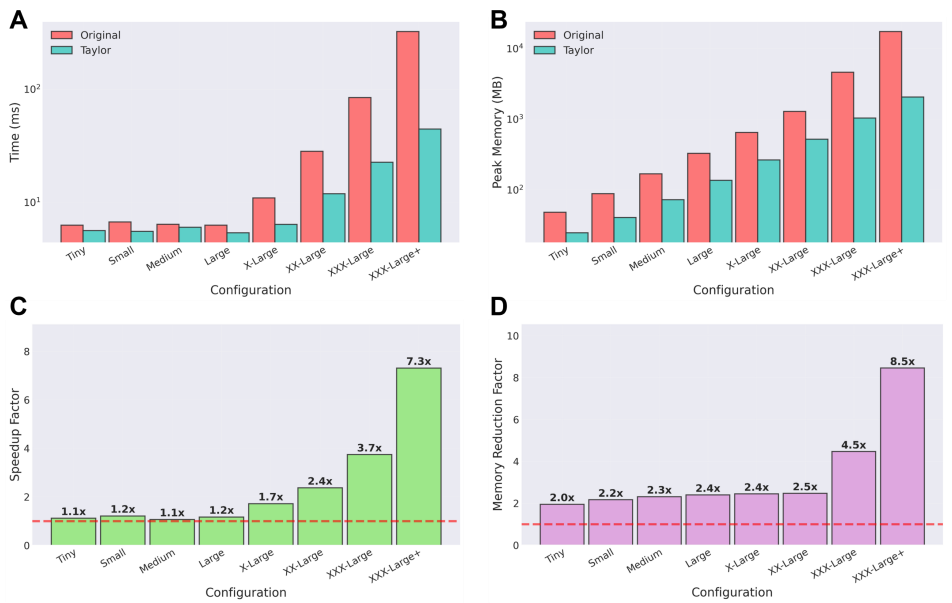
Time, peak memory, speedup (up to 7.3x), and memory reduction (up to 8.5x) across model configurations.
Publication: (Jeong* et al., 2025)